Showing posts with label vampires. Show all posts

Sunday, February 3, 2013

Only Lovers Left Alive - Jim Jarmusch's crypto-vampire love story


From Thor's troublesome brother to vampire. Tom Hiddleston is set to hit the screen again alongside  Tilda Swinton in Jim Jarmusch's undead romance Only Lovers Left Alive.

Tilda Swinton as Eve &
Tom Hiddleston as Adam

Adam (Hiddleston) is an (appropriately) underground rock musician depressed by the seemingly endless cruelty and suffering of humanity. He reunites with his enigmatic vampire lover, Eve (Swinton), but their idyll is not to last as Eve's crazy little sister, Ava (Mia Wasikowska), pops up to create havoc (as little sisters are wont to do).

Hopefully, this film will wipe out some of the sparkle and the moaning left over from Twilight and restore vampires to their former glory in popular imagination.

INTERESTING FACTS
1 - This film also features John Hurt (aka the voice of the dragon in Merlin) and Anton Yelchin.

2 - Rock music has a special attraction for vampires - Anne Rice's Lestat was a rock star for a while in The Vampire Lestat and so was Timmy Valentine in S. P. Somtow's Vampire Junction

The Vampire Lestat (Vampire Chronicles)
Vampire Junction

 3 - Tilda Swinton is the White Witch from Narnia. No, she does not appear in Lord of the Rings. But she does feature in some of my favorite films, including Burn After Reading and Michael Clayton with George Clooney, Derek Jarman's Caravaggio with Sean Bean, Orlando (based on the Virginia Woolf novel) and The Curious Case of Benjamin Button with Brad Pitt.

The Chronicles of Narnia: The Lion, Witch and the Wardrobe (Widescreen Edition)
Burn After Reading
Michael Clayton (Full Screen Edition)
Caravaggio (Special Edition)
Orlando
The Curious Case of Benjamin Button (The Criterion Collection)

Tuesday, September 6, 2011

A Vampire in Venice: Evan Rachel Wood at the Venice Film Festival


Evan Rachel Wood, who plays vampire queen Sophie-Anne Leclerq in True Blood, was at the opening of the 68th Venice Film Festival last week with the cast of George Clooney's latest directorial enterprise, The Ides of March.

The film opened the Festival on August 31 and Wood walked up the red carpet with co-stars George Clooney, Marisa Tomei, Philip Seymour Hoffman and Paul Giamatti, as well as supermodel Cindy Crawford who formed part of Clooney's retinue with her husband Randy Gerber.

Evan Rachel Wood as the vampire Sophie-Anne Leclerq in True Blood

Wood looked amazing in a Dolce & Gabbana outfit during the press conference in the morning, and, later that evening, in a white shirt dress by Alessandro Rich (above).

Other celebrities who were spotted on the red carpet included Diane Kruger (Troy), Violante Placido (The American) and Vittoria Puccini.

Sunday, August 14, 2011

Erzsebet Bathory - The Blood Countess of Hungary

Erzsebet Bathory


Any vampire fan is familiar with the name of the Hungarian Blood Countess Erzsebet Bathory.

Countess Bathory lived in 16th century Hungary, appropriately close (given the vampire associations) to the border with the Romanian region of Transylvania.

Bathory residence in Hungary
Photo by Charmaine Tanti

Elizabeth Bathory came from a family of Voivods of Transylvania, and her uncle Stephen was also King of Poland.

In 1610, she was accused of murdering over six hundred women and girls to bathe in their blood, believed to keep her skin youthful and translucent.

Bathory bathing in virgin blood - wax figures at Nyirbator
Photo by Charmaine Tanti
However, this accusation was most likely the fruit of a conspiracy against the Countess who refused to yield any of the estates that she had inherited from her deceased husband.

Bathory was tried and found guilty. She was walled up in a room where she died 4 years later, in 1614.

Bathory on trial - wax figures at Nyirbator
Photo by Charmaine Tanti
Bathory's legend grew and she is now considered the female version of Dracula. The Blood Countess and the Impaler share the same fate in popular culture as most people are more familiar with their legendary/fictional personas than with the real historical facts.

Bathory's legend inspired many stories in the 18th and 19th centuries, and still does so today. In 1729, her story was published by the Jesuit scholar Laszlo Turoczi in Tragica Historia. 

The witness accounts were published in 1817, and first gave rise to suspicions that the bloodbaths were pure fiction. However, the vampire craze that raged during the nineteenth century firmly rooted her within the ranks of the sadistic and bloodthirsty undead.

Bathory's legend has inspired anything from literature to music, plays and films. Kim Newman mentions her in his superb Anno Dracula, and she is one of the villains in Buffy the Vampire Slayer: Tales of the Slayer Vol 1.

She also features in Riyoko Ikeda's Berusaiyu No Bara Gaiden where she meets Oscar Francois de Jarjayes.

Hammer Horror made one of the first feature films about Elisabeth Bathory in 1970: Countess Dracula starring Ingrid Pitt.

The most recent movies about the Blood Countess include Juraj Jakubisko's Bathory (2008) starring Anna Friel; The Countess (2009) directed by and starring Julie Delpy; and Ulrike Ottinger's Die Blutgraefin (2011), starring Tilda Swinton.


For more information about the Countess' palace in Nyirbator, go to my blog Mad About Travel


Useful Links and references:


Thursday, February 17, 2011

La Morte Amoureuse

Theophile Gautier
Theophile Gautier's "La Morte Amoureuse" is a short vampire story about a young priest, Romuald, who is first haunted and then seduced by the beautiful vampire Clarimonde. First published in La Chronique de Paris in 1836, the story is one of the first and most influential vampire stories written in the nineteenth century.

Characters
Clarimonde - the femme fatale and loving vampire who falls in love with Romuald.
Romuald - the young priest whose moral dilemmas and erroneous choices prove tragic to himself and to Clarimonde.
Serapion - Romuald's spiritual guide and the antithesis to Clarimonde.


Synopsis
Romuald is a young man who has always lived a cloistered life studying to be a priest. On the day of his ordination, he espies a beautiful woman in the Cathedral and he falls in love with her. In spite of this, he takes his vows anyway and is assigned to a small parish.
One night a messenger arrives summoning him to the house of the beautiful courtesan Clarimonde who is dying. When he arrives there, Romuald is overwhelmed by the 'dead' woman's beauty and kisses her. Clarimonde wakes up and from that night onwards they become lovers. Romuald starts leading a double life: by day he is the timid, humble priest and by night he is his own arrogant and wealthy alter-ego, Clarimonde's lover.
Romuald the priest, however, is consumed by guilt and he confides in Serapion, an older priest who urges him to betray the vampire's whereabouts ...


"La Morte Amoureuse" was made into a TV film in 1997/8 in the series The Hunger. The title of the episode is Clarimonde and stars Audrey Benoit as Clarimonde, David la Haye as Romuald and James Bradford as Abbe Seraphon.


Read it or listen to it Online


The text in English:
http://www04.us.archive.org/stream/greatshortstori01brangoog#page/n11/mode/1up

The text in French:
http://classiques.uqac.ca/classiques/gautier_theophile/morte_amoureuse/morte_amoureuse_print.pdf

French audio version of the story:
http://www.litteratureaudio.com/livre-audio-gratuit-mp3/gautier-theophile-la-morte-amoureuse.html

The Film
http://welcome-to-monster-land.blogspot.com/2009/08/hungry-for-clarimonde.html
http://www.imdb.com/title/tt0608305/

Or buy new from Amazon


Sunday, August 2, 2009

Christabel: Coleridge's Unfinished Vampire Poem

Samuel Taylor Coleridge's poem Christabel (1816) is one of the first works of English literature dealing with a vampire femme fatale and with lesbianism. Although unfinished, it is very powerful and highly erotic, and sets the standards for later portrayals of female vampires.

Summary: Christabel, Baron Leoline's daughter, goes out at night to pray for her betrothed knight to come back safely to her, when she is accosted by a beautiful lady in distress. The lady's name is Geraldine, and she says that she had been kidnapped by some knaves. Christabel decides to help her, smuggles her into the castle and takes her to her room. Once there, Geraldine seduces Christabel and casts a spell on her which makes her unable to say the truth about Geraldine - namely that she is a vampire. In the morning, Sir Leoline meets Geraldine and discovers that she is the daughter of an old friend of his. Christabel tries to warn her father about the enchantress, but she cannot. Sir Leoline is so angry with her and so besotted by the vampire that he disowns Christabel and takes Geraldine under his wing.

The poem stops here and many critics have tried to give reasons why Coleridge never finished it even though he claimed that he had it all planned out.

One reason might be that the poem is so saturated with the poet's personal issues and psychological dilemmas that it proved quite impossible for him to distance himself enough from it to complete it.

Other critics propose that the reason why Coleridge did not manage to finish the poem resides in the poem itself, which, owing to its nature, defies closure.

Christabel contains many elements that were, or would become, common stock in literature about female vampires. Some of them are:
  • Geraldine is a snake-like creature whose eyes can mesmerize her victims

  • She pretends she is a damsel in distress to get herself invited into the castle

  • She takes over the mother's role when she seduces Sir Leoline

  • Her weapons, rather than brute force and fangs, are sex and seduction

  • Since she cannot enter a dwelling place unless she is invited inside, she gets Christabel to carry her across the castle's threshold

  • She shuns religious objects

  • She makes animals uneasy

For more information about Coleridge and Christabel:

Coleridge's poems: The Complete Poems (Penguin Classics) or
Samuel Taylor Coleridge - The Major Works (Oxford World's Classics)

Coleridge Biography: Coleridge: Early Visions, 1772-1804 (Part 1)
Coleridge: Darker Reflections, 1804-1834 (Part 2)

Online text of the poem available at: http://etext.virginia.edu/stc/Coleridge/poems/Christabel.html

Articles about 'Christabel': http://www.associatedcontent.com/article/53396/samuel_taylor_coleridges_christabel.html?cat=38
http://findarticles.com/p/articles/mi_hb3437/is_4_42/ai_n28961041/
http://british-poetry.suite101.com/article.cfm/psychosexual_tones_in_christabel

Sunday, July 26, 2009

Why do we like vampires?


Vampires have been with us from the beginning of time, from the myth of Adam's first wife Lilith, to our contemporary guardian angels in Twilight and Let the Right One In.

Other monsters have come and gone - the Leviathan, the Harpies and the Sirens. Scylla and Charybdis are relegated to the pages of Homer's epic. But vampires have gone all the way with us. They have developed from monstrous outsiders to incarnations of our sense of alienation, from alien creatures to beings that are possibly more human than us, more appreciative of the meaning and the possibilities of humanness.

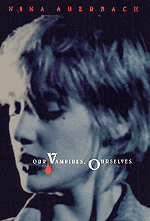
Maybe Nina Auerbach hit the nail on the head when she saw the connection. That our vampires are intricately and indelibly linked to ourselves.