Sunday, January 31, 2010

Lost Souls

If you love Anne Rice, you’ll love this!

Lost Souls by Poppy Z. Brite is one of those modern haunting and unforgettable vampire tales with haunting and unforgettable tragic characters that stay with you long after you’ve finished reading the book.

Poppy Z. Brite has become a cult writer among aficionados of the vampire genre. Two of her main characters, Ghost and Steve, were actually taken from her short stories, while others are featured in another novel, Drawing Blood, which, however, is not a sequel to Lost Souls.  Lost Souls is actually an expanded version of her short story ‘The Seed of Lost Souls’.

Lost Souls opens in New Orleans, a favourite setting among vampire story authors (see Fevre Dream and Anne Rice’s novels, among others). Three nomadic vampires arrive at Christian’s Bar where one of them, Zillah, impregnates a teenage girl. What follows is the story of their son, Nothing, who is adopted by ‘normal’ parents, and his search for a family and a sense of belonging.

Lost Souls? is the name of a band located in the typical American place in the middle of nowhere, Missing Mile. The members of the band are the tormented, messed up rocker Steve and his best friend Ghost, a seer and witch’s grandson, whose music lures Nothing to the small town. The story is about the adolescent search for identity and the existentialist and nihilist theme of the book is implied in the names of the characters, Nothing and Ghost. Youth are the children of the night, whether they are human or vampire, mortal or ancient.

In many ways, therefore, Brite’s novel is a song of Innocence and Experience, of Innocence lost as Nothing finds his family of vampires and is drawn into an incestuous relationship with his cruel and selfish father, Zillah. It is a compelling read that will have you turning pages and falling in love with the characters, with its sense of decadence and magic, savagery and poetry.

Main Characters 
(in order of appearance)

Jessy: Nothing’s teenage mother who dies giving birth to him (it’s gorier than it sounds)
Christian: the New Orleans barman who is also a very lonely vampire, hundreds of years old
Zillah: Cruel, narcissistic vampire, leader of the gang, father of Nothing and later his lover
Molochai: One of Zillah’s followers
Twig: the second of Zillah’s followers
Nothing: the protagonist of the story, in search of family and identity. He eats his friend.
Steve: musician, human, totally messed up, in love with Ann but has a funny way of manifesting his feelings for her
Ghost: a seer, witch’s grandson, totally weird but utterly lovable and wise. He can read people’s feelings
Ann: another messed up character, in love with Steve, hopping from one guy to another in search of love and finally gets her happy ending (Not!)
Wallace Creech: Jessy’s dad and Nothing’s granddad, a crusader against evil and vampires who manages to poison everyone with his cancerous blood

Title: Lost Souls
Author: Poppy Z. Brite
Published: 1993
Rating: 18+
Author's website: www.poppyzbrite.com 

Sunday, August 2, 2009

Christabel: Coleridge's Unfinished Vampire Poem

Samuel Taylor Coleridge's poem Christabel (1816) is one of the first works of English literature dealing with a vampire femme fatale and with lesbianism. Although unfinished, it is very powerful and highly erotic, and sets the standards for later portrayals of female vampires.

Summary: Christabel, Baron Leoline's daughter, goes out at night to pray for her betrothed knight to come back safely to her, when she is accosted by a beautiful lady in distress. The lady's name is Geraldine, and she says that she had been kidnapped by some knaves. Christabel decides to help her, smuggles her into the castle and takes her to her room. Once there, Geraldine seduces Christabel and casts a spell on her which makes her unable to say the truth about Geraldine - namely that she is a vampire. In the morning, Sir Leoline meets Geraldine and discovers that she is the daughter of an old friend of his. Christabel tries to warn her father about the enchantress, but she cannot. Sir Leoline is so angry with her and so besotted by the vampire that he disowns Christabel and takes Geraldine under his wing.

The poem stops here and many critics have tried to give reasons why Coleridge never finished it even though he claimed that he had it all planned out.

One reason might be that the poem is so saturated with the poet's personal issues and psychological dilemmas that it proved quite impossible for him to distance himself enough from it to complete it.

Other critics propose that the reason why Coleridge did not manage to finish the poem resides in the poem itself, which, owing to its nature, defies closure.

Christabel contains many elements that were, or would become, common stock in literature about female vampires. Some of them are:
  • Geraldine is a snake-like creature whose eyes can mesmerize her victims

  • She pretends she is a damsel in distress to get herself invited into the castle

  • She takes over the mother's role when she seduces Sir Leoline

  • Her weapons, rather than brute force and fangs, are sex and seduction

  • Since she cannot enter a dwelling place unless she is invited inside, she gets Christabel to carry her across the castle's threshold

  • She shuns religious objects

  • She makes animals uneasy

For more information about Coleridge and Christabel:

Coleridge's poems: The Complete Poems (Penguin Classics) or
Samuel Taylor Coleridge - The Major Works (Oxford World's Classics)

Coleridge Biography: Coleridge: Early Visions, 1772-1804 (Part 1)
Coleridge: Darker Reflections, 1804-1834 (Part 2)

Online text of the poem available at: http://etext.virginia.edu/stc/Coleridge/poems/Christabel.html

Articles about 'Christabel': http://www.associatedcontent.com/article/53396/samuel_taylor_coleridges_christabel.html?cat=38
http://findarticles.com/p/articles/mi_hb3437/is_4_42/ai_n28961041/
http://british-poetry.suite101.com/article.cfm/psychosexual_tones_in_christabel

Sunday, July 26, 2009

Why do we like vampires?


Vampires have been with us from the beginning of time, from the myth of Adam's first wife Lilith, to our contemporary guardian angels in Twilight and Let the Right One In.

Other monsters have come and gone - the Leviathan, the Harpies and the Sirens. Scylla and Charybdis are relegated to the pages of Homer's epic. But vampires have gone all the way with us. They have developed from monstrous outsiders to incarnations of our sense of alienation, from alien creatures to beings that are possibly more human than us, more appreciative of the meaning and the possibilities of humanness.

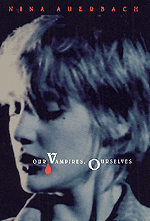
Maybe Nina Auerbach hit the nail on the head when she saw the connection. That our vampires are intricately and indelibly linked to ourselves.